LML Team at “Jaszowiec 2026”
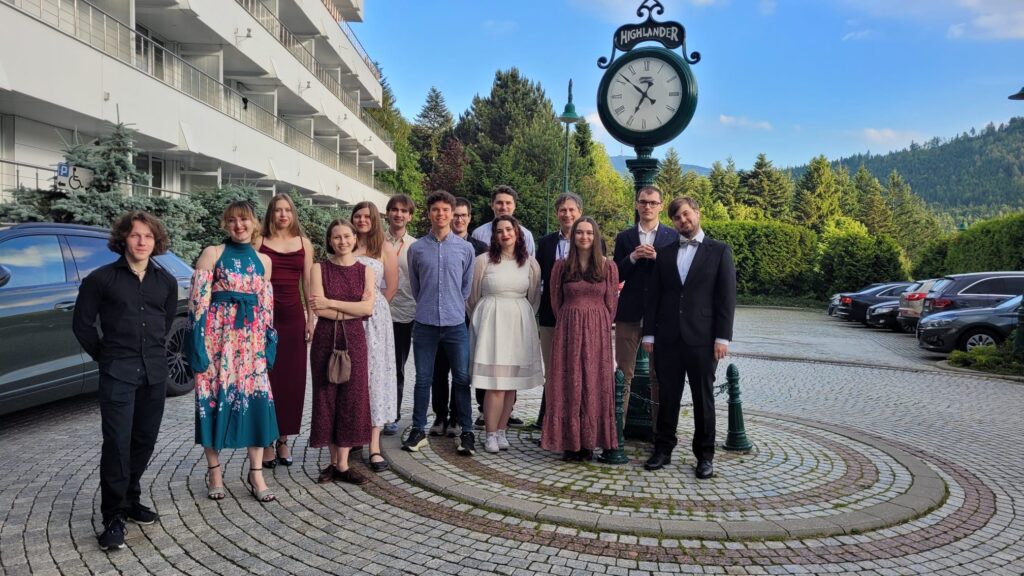
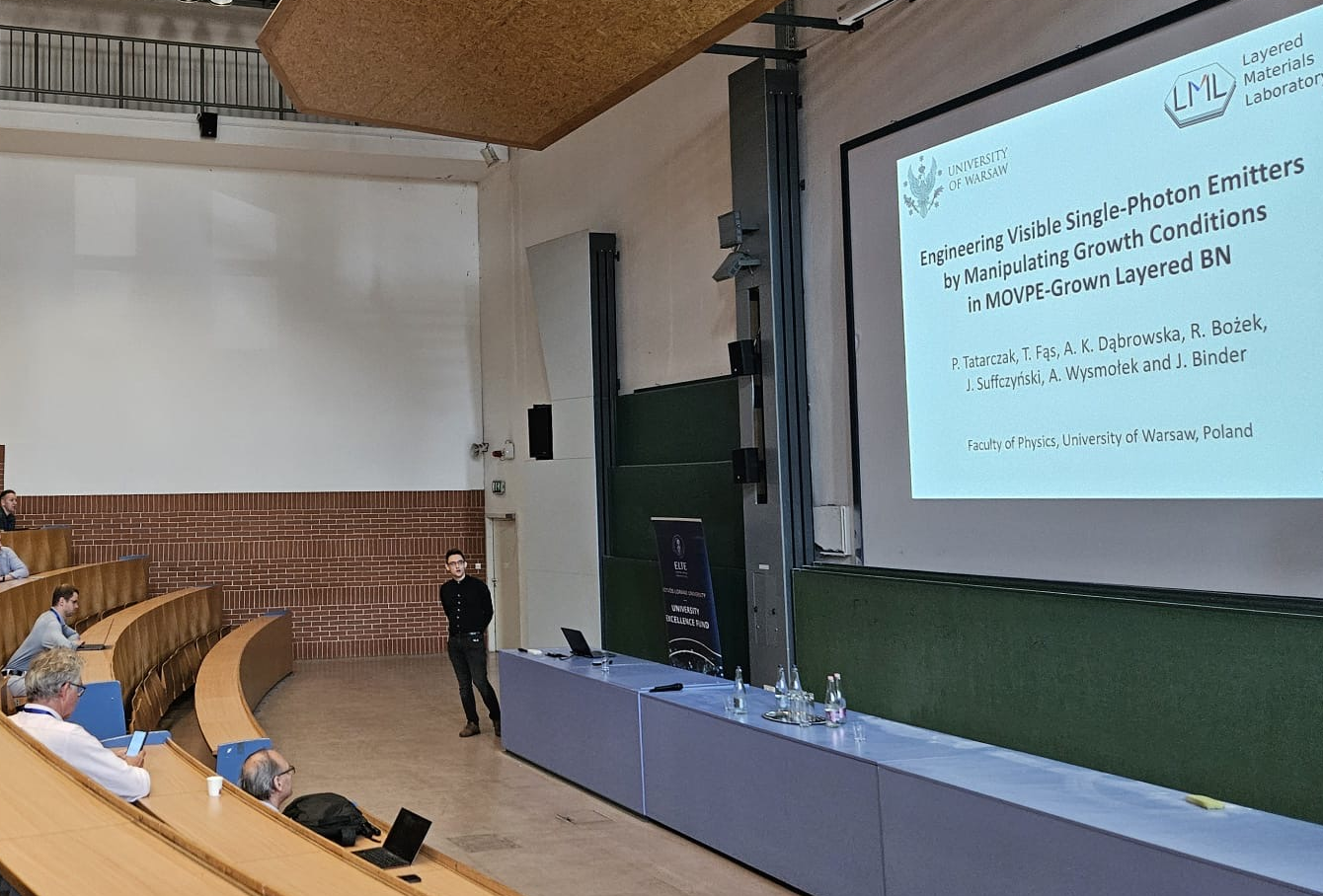
From 13 to 19 June, Szczyrk hosted the 54th International School & Conference on the Physics of Semiconductors, “Jaszowiec 2026.” Our group had a strong presence at the conference. We presented more than a dozen posters on our latest results on boron nitride, covering topics such as electrical conductivity, defects, polytypism, homoepitaxy, neutron detectors, and the integration of BN with other materials. Three oral presentations were also given by our students: Izabela Rogala on moiré structures in boron nitride, Lena Miler on hydrogen complexes in the BN lattice, and Magda Kopczyńska on tunneling in BN–GaN nanowire structures. The meeting inspired many valuable discussions and promising ideas for future collaborations.
Our Group Member Jakub Iwański Awarded the Prestigious FNP START Scholarship!
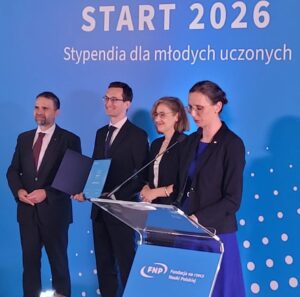
The FNP START program is Polish oldest scholarship initiative for the best young researchers under 30 across all scientific disciplines. Among 807 applications submitted to the competition this year, 100 of the most promising young researchers in Poland were selected after a multi-stage evaluation of their scientific accomplishments. We are proud that among this year’s laureates was our group member, Jakub Iwański. The awards were ceremonially presented at the Royal Castle on Wawel on June 13, 2026. This is a tremendous success and a well-deserved recognition of his hard work, talent, and scientific commitment. We warmly congratulate Jakub and wish him many more achievements in the years ahead — this scholarship is surely a strong beginning of an excellent scientific career!
Our Participation in DSQT 2026 and Nanotech Poland 2026 & 9th NIBS
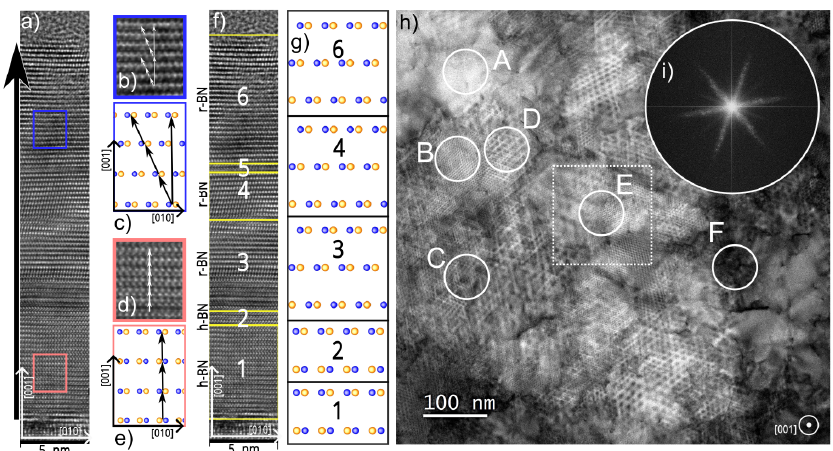
Moiré Patterns and Polytype Mapping of Epitaxial Boron Nitride by Electron Microscopy
Recently, one of our youngest students, Izabela Rogala, published a paper in 2D Materials. The article, titled “Moiré Patterns and Polytype Mapping of Epitaxial Boron Nitride by Electron Microscopy,” presents a STEM-based method to identify interlayer twist angles and map polytype domains in MOVPE-grown boron nitride. It demonstrates that moiré patterns observed in STEM can separate twist and stacking effects on the nanometer scale, which is essential for understanding and tuning the electronic and optical properties of epitaxial BN.
Enjoy the read!
2nd Finnish-Polish Symposium on Nitride Semiconductor Science and Technology
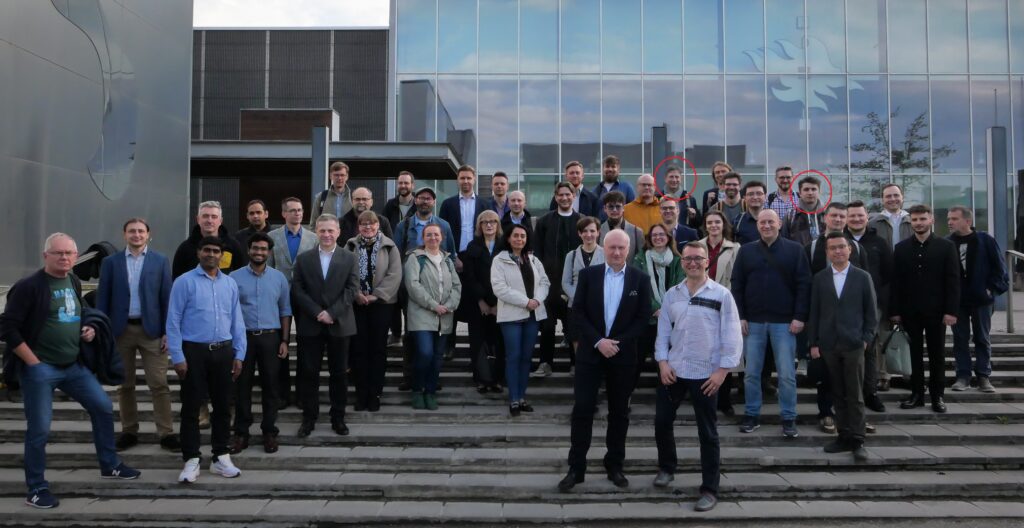
From May 18–20, 2026, our representatives participated in a Polish-Finnish networking meeting aimed at highlighting the collaboration between researchers from Poland and Finland in the field of nitride semiconductors. Prof. Andrzej Wysmołek delivered an overview presentation on the potential of our boron nitride, titled “Epitaxial BN: growth, properties and applications.” Additionally, Bartosz Furtak presented our capabilities in defect research with his talk: “Positron annihilation spectroscopy framework for vacancy type defect investigation in epitaxial boron nitride.” During the event, participants discussed new directions and collaborative research areas to pursue with our Finnish colleagues.
Boron Nitride Workshop 2026 in Pohang
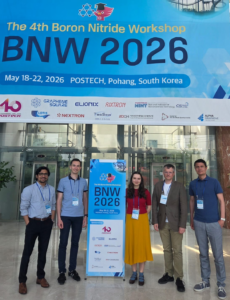
At BNW 2026 in Pohang, Korea, held from May 18 to May 22, 2026, our team introduced fresh, innovative ideas centered around MOVPE-grown BN to the conference. Johannes Binder delivered an invited talk on BN membranes, and Izabela Rogala presented a contributed talk on Moiré structures in our BN. Their presentations sparked great interest. Jakub Iwański and Bazlul Karim complemented the program with posters which led to many valuable discussions. Jakub Iwański’s poster received the Bronze Winner prize for the Best Poster Award. Our team, as always, handled everything with ease, and we are already looking forward to meeting again next year!
1st Layered Materials Gathering at Chęciny

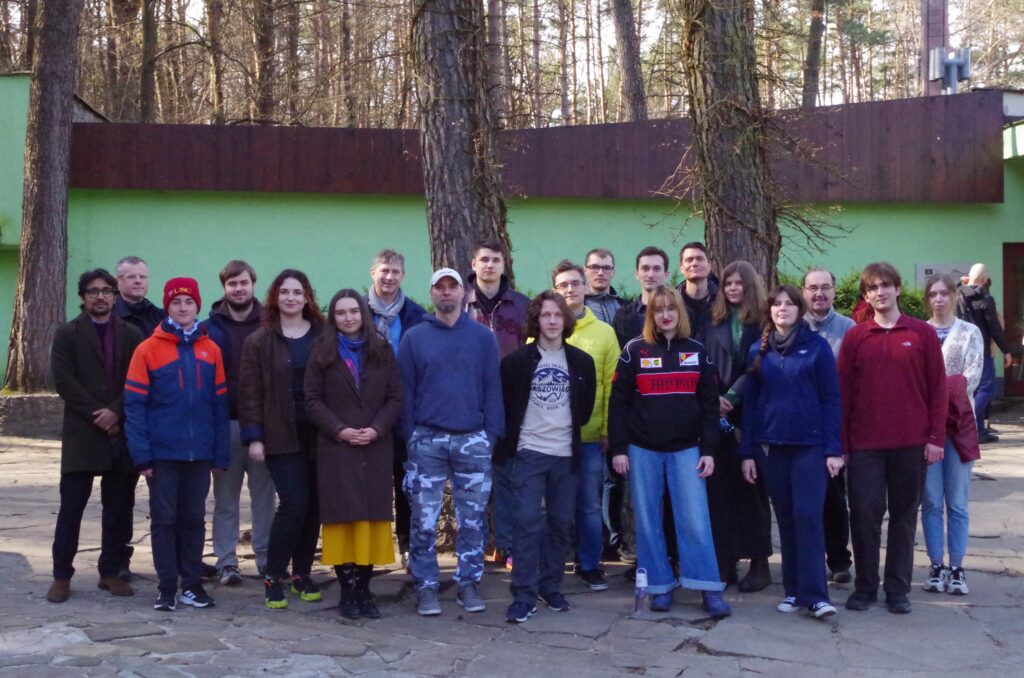
On March 13–15, our group held the 1st Layered Materials Gathering at the ECGE in Chęciny. After check-in,
Prof. Andrzej Wysmołek presented the history of the Faculty
of Physics, the Solid State Physics Division, and the early beginnings of our group. Saturday was devoted to presentations by all group members, followed by an evening discussion summarizing the results and outlining new research directions and project ideas. On Sunday, after check-out, we visited the Raj Cave together. The meeting was especially valuable as an opportunity to share results, introduce new students to the group’s work, and spend time together outside the daily laboratory routine.